| 🏠 Home | ← Discovery Series |
The Emergence of Space from Relation and Organization
Universe Crystal Discovery Series — Part 12
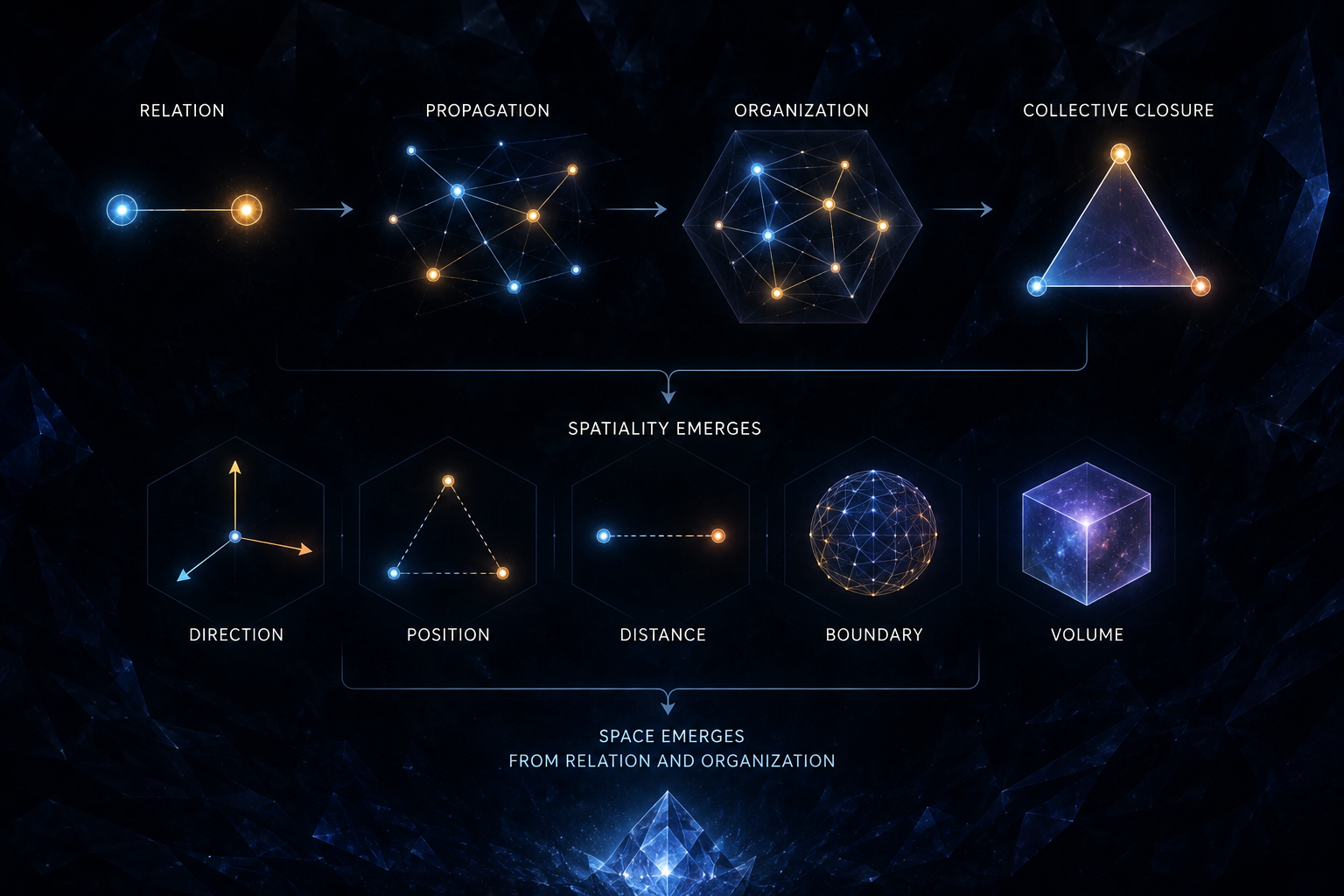
We usually think of space as something that already exists.
Then things appear inside it.
Particles have positions. Objects have sizes. Things have distances from one another. They can move up, down, left, right, forward, and backward.
Space seems to be a container that was already there.
But Universe Crystal begins with a different idea:
Space may not be fundamental.
Space may emerge from relations and organization.
What Is Space Without Relation?
Imagine that there is only one isolated thing in the universe.
Nothing else exists.
There is no relation.
Can we still say that it is:
above something?
below something?
to the left?
to the right?
far from something?
near something?
Where is it?
These questions lose their meaning.
Because “left” and “right” require something to relate to.
“Near” and “far” require comparison.
“Position” requires relation.
“Direction” requires relation.
Even “distance” is a relation between two things.
So many of the basic properties we normally associate with space already depend on relation.
This leads to a simple question:
If the basic properties of space are themselves relations, does space really have to exist before relation?
Perhaps not.
Starting with Open Relations
Universe Crystal begins with Relation.
Relation can propagate.
One organization can form a relation with another.
More relations can form an open texture.
As these relations propagate, we can begin to describe:
direction.
position.
near and far.
distance.
We did not first create a space and then place these relations inside it.
Instead:
The existence of relations makes these spatial concepts possible.
Space begins to appear through them.
But Where Does Volume Come From?
There is another important property of space.
An object does not only have a position or a distance from something else.
It also has:
size.
It occupies:
volume.
Where does this spatial extension come from?
Universe Crystal suggests that this may involve another kind of relation.
Not simply an open relation between one organization and another,
but:
relations within the organization itself.
When relations inside an organization form collective closure, the organization begins to develop its own structure.
We can then distinguish:
interior
boundary
exterior
The organization is no longer simply “located in space.”
It begins to have a spatial structure of its own.
It can have:
shape.
extension.
volume.
So spatial properties may arise through two different ways of organizing relation:
open relations
and
closed relations within an organization.
Space May Not Be a Thing
At this point, another possibility appears.
We normally say:
“Space exists.”
But perhaps space is not an independent thing.
Perhaps what we call space is the overall manifestation of many different relations and organizations.
For example:
up, down, left, right, forward, backward
come from directional relations.
position, near and far, distance
come from relations between organizations.
interior, boundary, exterior
come from the closure of an organization.
shape and volume
come from the spatial structure of an organization itself.
In other words:
We may think we are describing space, while we are actually describing relations and organizations.
Then Why Three Dimensions?
This leads to a deeper question:
Why is space three-dimensional?
Universe Crystal has found that three organizations can form the simplest collective closure:
A → B → C → A
Two organizations can form a relation.
But three organizations can form the simplest closed structure.
This gives three a special organizational significance.
It therefore raises a natural question:
Could three-dimensional space be related to this three-part collective closure?
This remains a structural hypothesis under investigation.
We have not yet developed it into a complete mathematical proof.
But it offers a direction worth exploring:
Perhaps three-dimensional space was not simply given.
Perhaps it is related to the way organization forms collective closure.
Where Does Space Begin?
For now, we can summarize this exploration with a simple picture:
Relation
↓
Propagation
↓
Organization
↓
Collective Closure
↓
Spatiality
We do not begin with an already existing space.
We begin with relation.
Relation propagates through open texture and creates spatial relations between organizations.
Relation can also form closure within an organization, allowing the organization itself to develop spatial structure.
Eventually, properties such as:
position, direction, distance, interior, boundary, shape, and volume
begin to appear.
How these spatial relations may further give rise to geometry, metric, and a complete structure of space is a question for the next stage of the investigation.
For now, Universe Crystal proposes something more fundamental:
Space may not be the container in which the universe exists.
Space may be what emerges when Relation becomes organized.
| ← Part 11 | Discovery Series |
Reviews & Discussion
We welcome constructive feedback, questions, and academic discussion.