| 🏠 Home | ← Universe Crystal Essays |
Universe Crystal Essay 004
How Does Universe Crystal Organize Electric Charge?
From Organizational Weaving to Charge, Attraction, Repulsion, and Electric Force
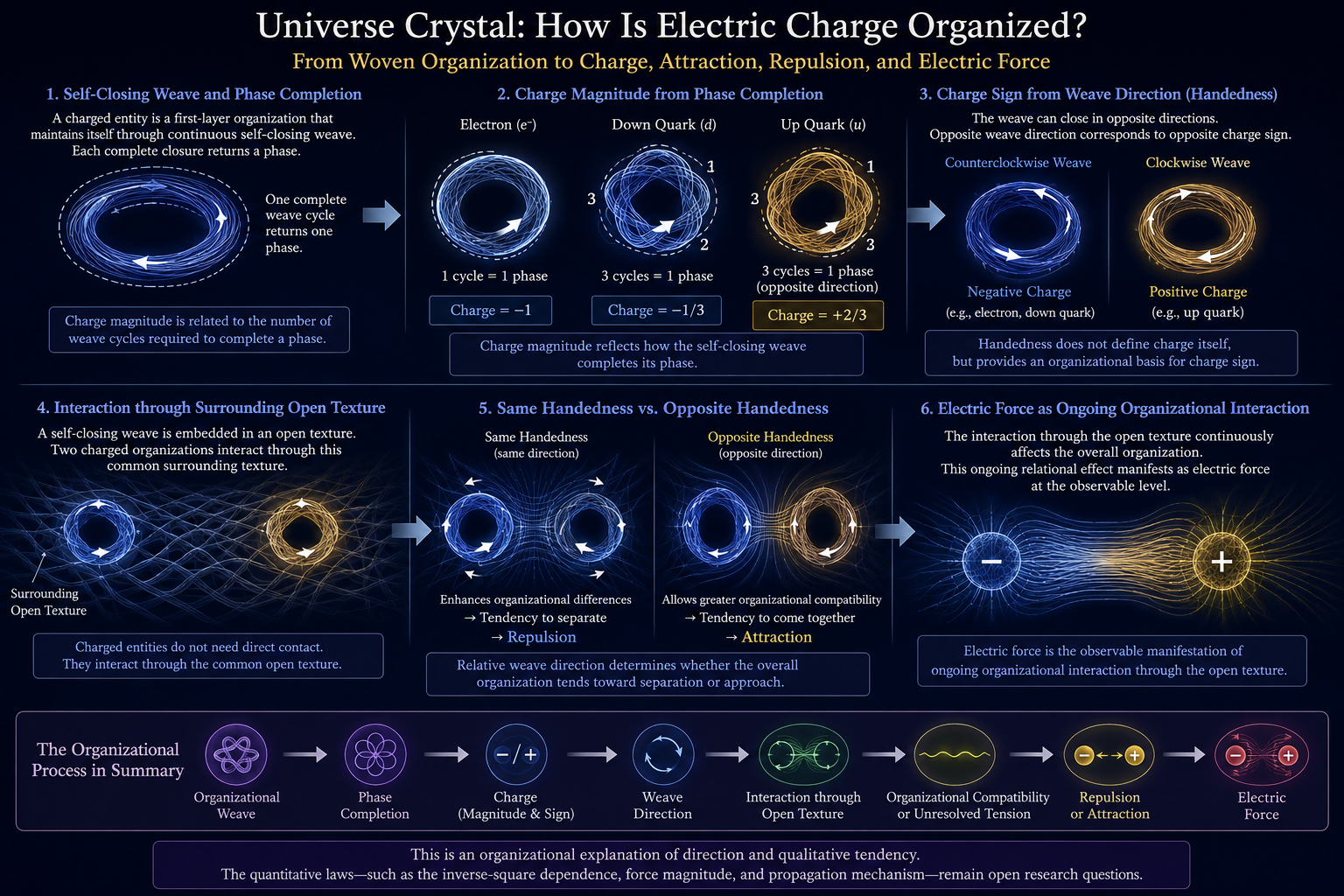
Electric charge is one of the most fundamental properties of matter. An electron carries a charge of −1, while up and down quarks carry fractional charges of +2/3 and −1/3. Like charges repel, unlike charges attract, and charged objects exhibit electric force across space. Modern physics describes these phenomena with remarkable precision, yet from the organizational perspective of Universe Crystal, a deeper question remains: Can electric charge, its positive and negative signs, attraction and repulsion, and electric force be understood as different expressions of the same underlying organizational process?
Universe Crystal approaches this question through organizational weaving. A First Level Organization maintains itself through continuous self-closure, and each complete closure returns a phase. The number of weaving cycles required to complete such closure provides a possible organizational basis for the magnitude of charge. From this starting point, the sign of charge can be further related to the direction of the weaving, while the interaction between different charged organizations through the surrounding Open Texture may determine whether the overall organization favors separation or convergence. In this way, charge magnitude, charge sign, attraction, repulsion, and electric force can be studied within one organizational process.
The central question of this essay is therefore not simply how to explain a particular charge value, but how to establish a continuous relation from organizational weaving to electric interaction: How does organizational weaving form charge, how does the direction of weaving correspond to the positive and negative signs of charge, and how can the relation between different charged organizations appear as attraction, repulsion, and electric force?
Charge as a Completed Weaving Phase
A First Level Organization is not formed by a single act of closure and then left unchanged. It maintains itself through continuous self-closure: Open Texture continually returns upon itself, forming an organized propagation pattern capable of maintaining its own organization. Within this process, each complete closure returns a phase, and electric charge can first be approached through this phase-completion structure.
For the electron, one complete weaving cycle returns the organization to its full closure phase and therefore corresponds to one unit of charge, expressed as −1. For quarks, closure can be understood as taking a different organizational pattern in which the return is distributed across three cycles, so that each cycle corresponds to one third of the full phase. In this way, −1/3 can be associated with down-type quark weaving, while the opposite weaving direction corresponds to +2/3 for up-type quark weaving.
The precise physical meaning of these values remains a subject for further research, but an organizational relation can already be proposed: the magnitude of electric charge can be related to the degree of phase completion within a self-closing weaving pattern. Charge is therefore no longer treated only as an isolated numerical property attached to a particle; it can be approached as a discrete organizational characteristic arising from the completion structure of its weaving.
This interpretation can also be extended to composite structures. A proton contains two up-type quarks and one down-type quark, giving +2/3 + +2/3 − 1/3 = +1, while a neutron contains one up-type quark and two down-type quarks, giving +2/3 − 1/3 − 1/3 = 0. In this sense, the charge of a composite structure can be understood as the organizational sum of the charges carried by the First Level Organizations that constitute it, without requiring a separate source of charge for the composite object.
However, phase completion primarily provides an organizational interpretation of charge magnitude. The positive and negative character of charge requires the directional structure of the weaving itself to be considered further.
Charge Sign and Winding Direction
A weaving process has not only a degree of phase completion but also an organizational direction. A closed propagation can follow one direction or the opposite direction, so two organizations can have similar phase structures while possessing opposite winding orientations. For simplicity, these orientations can be described as clockwise and counterclockwise, or more generally as opposite forms of winding handedness.
Within the current Universe Crystal interpretation, positive and negative charge can be associated with opposite winding handedness. One orientation can correspond to positive charge, while the opposite orientation corresponds to negative charge. The point is not to define electric charge itself as handedness, but to consider winding direction as a possible organizational source of the sign of charge. Charge can therefore be approached through two related organizational aspects: its magnitude, associated with the degree of phase completion, and its sign, associated with the direction of the weaving.
This distinction becomes particularly important when two charged organizations coexist. A Self-Closed Texture does not become completely separated from the Texture around it simply because it has formed a closure. It remains embedded within Open Texture and continues to exist within the same relational environment. Consequently, the weaving structure of a charged organization is not confined to itself alone; through the surrounding Open Texture, it participates in a wider organizational relation. It is within this relational environment that the interaction between charges can be considered.
The Relation Between Closed Weaving and Surrounding Open Texture
A Self-Closed Texture can be understood as a persistent organization within Open Texture. It possesses its own closed structure while remaining embedded in a larger relational Texture. Closure therefore does not eliminate the relation between the organization and its environment; rather, it forms a specific organization that can maintain itself within Open Texture.
From this perspective, charge should not be understood only as a mathematical number attached to a particular spatial position. The organizational pattern associated with charge exists within Open Texture and participates in a wider relational structure. Two charged organizations may be separated in space without being disconnected from one another, because both remain embedded within the same Open Texture and can therefore participate in a common relational structure.
Once this interaction is considered, the relative winding direction of the two organizations becomes significant. If two organizations have the same winding direction, they possess the same directional organization; if they have opposite winding directions, their directional organizations are reversed. Attraction and repulsion can therefore be investigated as two different manifestations of these relative organizational relations.
Same Handedness and Opposite Handedness
Consider two charges with the same winding direction. Two positive charges have the same handedness, and two negative charges likewise have the same handedness. When their surrounding organizational patterns interact through Open Texture, the same directional organization may reinforce an unresolved organizational difference between them, causing the overall configuration to favor greater separation. At the observable level, this organizational configuration appears as repulsion between like charges.
For two charges with opposite winding directions, one organization closes along one direction while the other closes along the opposite direction. When their surrounding organizational patterns interact through Open Texture, opposite handedness may permit a greater degree of organizational compatibility, causing the overall configuration to favor reduced separation. At the observable level, this appears as attraction between unlike charges.
Thus, within the current organizational interpretation, same and opposite winding directions are not merely classification labels. They may determine different organizational tendencies in the relation between charged structures. The relationship can be expressed as follows: the same handedness may favor a configuration of greater separation, while opposite handedness may favor a configuration of greater convergence; at the observable level, these appear respectively as repulsion and attraction.
This is an organizational interpretation of the direction of electric interaction rather than a derivation of its complete dynamics. The deeper question is why such organizational relations produce the electric effects we observe, and how the strength and distance dependence of those effects arise from the structure of Open Texture.
Attraction and Repulsion as Organizational Reorganization
The interaction between charged organizations can be understood within a broader organizational principle of Universe Crystal: a continuing organization tends toward configurations that support the continuation of its organization. When relations between different organizations produce greater unresolved organizational tension, the overall configuration may reorganize in a way that reduces that tension; when a relation permits greater organizational compatibility, the configuration may reorganize toward that compatibility.
For like charges, increasing the separation between them can reduce the interaction between similarly handed organizational patterns, so the overall organization appears to favor separation. For unlike charges, decreasing the separation can increase the relation between oppositely handed organizations, so the overall organization appears to favor convergence. In this way, like sign → separation → repulsion and unlike sign → convergence → attraction can be understood as two outcomes within the same organizational reorganization process.
The significance of this interpretation is that attraction and repulsion do not need to be introduced as two completely independent fundamental rules. They may instead be different directional expressions of the same organizational relation under different relative winding structures. The positive and negative signs of charge distinguish the winding directions, while the relative winding directions of two charges determine the organizational tendency of their interaction.
A Simple Analogy: Opposing Gear Directions
To visualize this directional organizational relation, consider the analogy of two gears. For two gears to mesh smoothly, their local rotational directions at the interface need to form a compatible relation. If the gears are forced into an incompatible rotational relationship, the interface produces resistance. The analogy therefore helps illustrate why relative direction can influence organizational compatibility.
The analogy is not intended as a description of the physical mechanism of electric charge. Charges do not need to make mechanical contact, and electric interaction is not proposed to arise from mechanical collision between two objects. The gear analogy serves only as an intuitive illustration of the possible organizational role of relative winding direction. In Universe Crystal, the actual interaction is understood as occurring through the surrounding Open Texture.
What Is Electric Force?
When two charges exhibit attraction or repulsion, a deeper question naturally arises: what exactly is the “force” involved in this interaction? In conventional physical language, force is often described as a quantity acting between objects and changing their motion. From the organizational perspective of Universe Crystal, however, a more fundamental starting point can be the continuing relational process between organizations.
A charged Self-Closed Texture maintains its organization through continuous weaving, while remaining embedded within the relational environment formed by surrounding Open Texture. Another charged organization is embedded in the same Open Texture. The two organizations therefore participate in a shared relational structure, and their interaction changes the overall organizational configuration.
At the observable level, this change appears as a directional effect: like charges exhibit repulsion, while unlike charges exhibit attraction. Within this organizational interpretation, electric force can therefore be understood as the observable expression of an ongoing organizational interaction between charged organizations through Open Texture.
The important point is the connection between force and relation. Force does not have to be introduced first as an independent entity existing between two charges; it can instead be investigated as the observable consequence of an ongoing relation between organizations. How that relation propagates in detail, how it produces a definite force magnitude, and how it corresponds to the mathematical structure of the electromagnetic field remain subjects for further research.
Charge, Sign, and Electric Force as One Organizational Process
The organizational interpretation can now be connected as a single process. Charge magnitude is related to phase completion within organizational weaving, while charge sign is related to the direction of that weaving. A charged organization participates in a wider relational structure through Open Texture. When two charged organizations interact, their relative winding directions may cause the overall configuration to favor separation or convergence; the same handedness may produce a stronger organizational difference and favor separation, while opposite handedness may allow greater organizational compatibility and favor convergence. At the observable level, these configurations appear as repulsion or attraction, while the continuing relational interaction appears as electric force.
The process can therefore be summarized as:
Organizational weaving → phase completion → electric charge → winding direction → interaction through Open Texture → organizational compatibility or unresolved tension → repulsion or attraction → electric force.
The significance of this sequence is that charge magnitude, charge sign, attraction, repulsion, and electric force are no longer treated as unrelated physical facts. They can be studied as different manifestations of one underlying organizational process. Charge expresses a particular completion structure of organizational weaving, its positive or negative sign is associated with a difference in winding direction, and the interaction between charged organizations expresses the relation between those different organizational structures.
What This Account Has Not Yet Explained
This organizational interpretation leaves several important questions open, and these questions define the next stage of research.
The first is the distance dependence of electric interaction. The observed electrostatic force between point charges follows Coulomb’s law, F = kq₁q₂/r², while the current Universe Crystal interpretation addresses the organizational direction of interaction: same handedness favors separation and opposite handedness favors convergence. It does not yet explain why the interaction strength follows precisely an inverse-square dependence on distance. The exponent 2 therefore remains an open organizational question.
The second is the quantitative magnitude of electric force. The present framework has not yet derived the Coulomb constant from the structure of Open Texture, nor has it explained why electromagnetic interaction has the measured strength it does or why that strength has its observed relationship to the strong and weak interactions. A more complete physical account would need to establish a connection between the organizational structure of Open Texture and measurable interaction strength.
The third is the detailed mechanism of propagation. Open Texture, organizational interaction, and winding compatibility provide a conceptual organizational framework, but they do not yet constitute a complete mathematical dynamical structure for propagation. Future research must investigate what mathematical organization can describe this propagation and how an electromagnetic field can emerge from more fundamental relations within Texture.
These are not peripheral details to be added after the interpretation is complete. They are the next research questions that arise directly from the organizational framework.
From Charge to Electric Interaction
Electric charge can be understood as an organizational property associated with self-closing weaving. Its magnitude can be related to phase completion, while its positive or negative sign can be associated with winding direction. A charged organization remains embedded within Open Texture and can therefore participate in a wider relational structure. When two charged organizations interact through Open Texture, their relative winding directions may cause the overall configuration to favor separation or convergence, which appears at the observable level as repulsion or attraction. The continuing relational interaction is then observed as electric force.
The current Universe Crystal interpretation can therefore be summarized as follows: electric charge is associated with organized weaving and phase completion; its sign is associated with winding direction; attraction and repulsion arise from the interaction between charged patterns with different organizational relations; and electric force is the observable expression of this continuing organizational interaction.
The deeper question is therefore no longer simply why a particle possesses electric charge. It becomes a broader organizational question:
How does a particular mode of organizational weaving form electric charge, produce the distinction between positive and negative charge, interact with other charged organizations through Open Texture, and ultimately produce the quantitative laws observed in electromagnetism?
This defines the next level of the Universe Crystal investigation.
Read and comment on Medium:
How Does Universe Crystal Organize Electric Charge?
| ← Essay 003 | Universe Crystal Essays | Essay 005 → |
Reviews & Discussion
We welcome constructive feedback, questions, and academic discussion.