| 🏠 Home | ← Universe Crystal Essays |
Universe Crystal Essay 010
Universe Crystal essay 010 — How Electron Re-Propagation Forms the Atom
Closure and the Emergence of Discrete Cloud Propagation Modes
Abstract
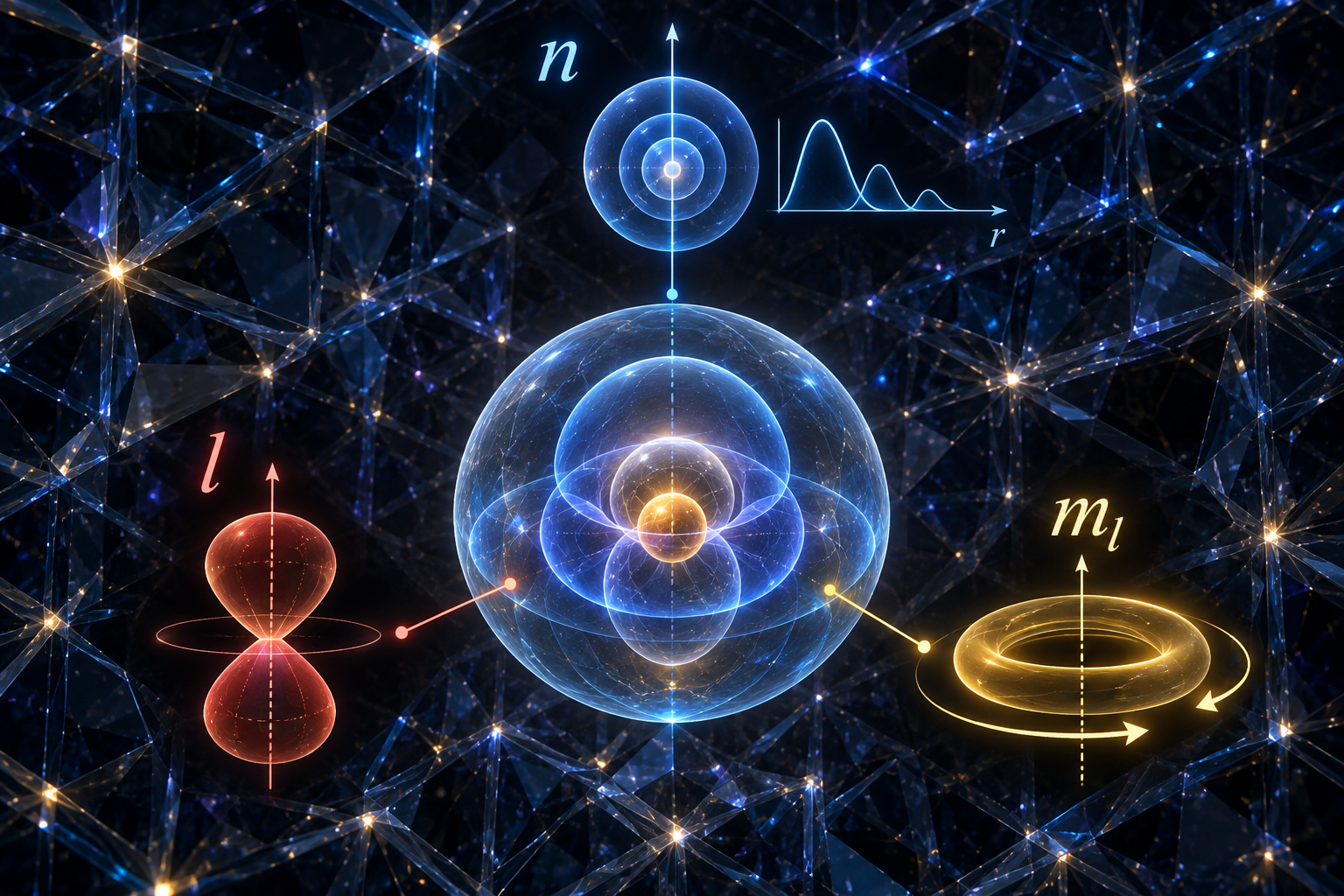
Essay 009 examined how Residual Closure within Interlocking Texture forms the atomic nucleus. Essay 010 continues the same higher-level emergence question: how does an already formed atomic nucleus interact with an already existing electron organization to form the atom? This essay proposes that the key process is not simply that an electron becomes “bound” to the nucleus, but that the electron undergoes Re-Propagation within a new nucleus–electron relational context. The organization of the nucleus constrains and reorganizes electron propagation, transforming open propagation into Cloud Propagation. Cloud Propagation possesses radial, angular, and azimuthal structural degrees of freedom. Each degree of freedom is subject to a distinct form of Closure, and these Closure conditions restrict continuous propagation possibilities to discrete, self-consistent modes represented by n, l, and m_l.
The essay also addresses a central question: why do some orbital modes have angular structure while the simplest mode does not? The simplest Cloud Propagation can remain spherically symmetric, corresponding to l=0 and the s mode. As an atom accommodates more electrons, additional distinguishable propagation modes are required, and angular degrees of freedom become structurally important. At the same time, photons carry angular momentum, so electron absorption and emission processes require angular-momentum exchange. This gives angular structure a direct physical role in electronic transitions. From the Universe Crystal perspective, s, p, d, and f can therefore be interpreted as different orders of angular organization emerging within Cloud Propagation, rather than as merely pre-existing orbital shapes.
1. From the Atomic Nucleus to the Atom
Essay 009 established the atomic nucleus as a higher-level organization: interlocking propagation among quarks produces Residual Closure, and Residual Closure forms a new nuclear organization. Essay 010 addresses the next step: once the nucleus exists, how does the atom emerge?
Interlocking Texture → Residual Closure → Atomic Nucleus
Atomic Nucleus + Electron Propagation → Re-Propagation → Closure → Atom
The organizational level has now changed. The electron already exists as an organization, and the atomic nucleus already exists as a higher-level organization. When the electron enters a new relation with the nucleus, its propagation is reorganized within that new context. This process is called Re-Propagation.
The atom is therefore not simply a collection of a nucleus and an electron. It is a new organization produced when two existing organizations enter a new relational context and generate a new, self-consistent propagation organization.
2. The Electron Before Re-Propagation
Outside a bound atomic organization, an electron can be described by open propagation modes. Such propagation does not require a finite spatial domain to support a globally self-consistent bound pattern. It can extend over arbitrarily large regions and can be associated with a continuous range of propagation possibilities.
When the electron enters the relational environment established by an atomic nucleus, the situation changes. The nuclear charge produces a Coulomb potential that provides a binding relation. The electron can no longer realize an arbitrary open propagation pattern; its propagation must reorganize within the new relation.
Electron Organization → Nuclear Relation → Electron Re-Propagation
Cloud Propagation is therefore not a fixed geometric shape possessed by the electron in advance. It is a propagation organization that emerges when the electron is reorganized within the nucleus–electron relation.
3. Electron Re-Propagation: From Open Propagation to Cloud Propagation
Re-Propagation does not mean that an electron behaves like a classical object that travels around a path and then repeats that path. It means that an already existing organization realizes its propagation again under a newly established relational context.
The atomic nucleus establishes a new organization of the electron’s environment. Electron propagation is consequently reorganized into a bound propagation pattern, giving rise to Cloud Propagation.
Atomic Nucleus + Electron → New Relation → Re-Propagation → Cloud Propagation
This is the key organizational step in atomic formation. The atom is not simply “nucleus plus electron”; rather, the nuclear relation reorganizes electron propagation, and that reorganized propagation participates with the nucleus in forming a new organizational level.
4. Why Bound Cloud Propagation Must Form a Closed Mode
A bound propagation pattern faces a basic structural requirement: propagation cannot simply terminate at an arbitrary boundary. Once propagation is constrained by the nuclear relation, it must remain self-consistent throughout its allowed domain. In standard quantum mechanics, this is expressed through the eigenvalue problem in the Coulomb potential together with physical conditions such as regularity near the origin and normalizability at large distance.
In Universe Crystal language, these conditions indicate that Cloud Propagation must realize a self-consistent pattern across its complete propagation domain. This self-consistent completeness is what is called Closure.
Binding Conditions → Restricted Propagation Domain → Self-Consistent Propagation → Closure → Discrete Allowed Modes
Closure is therefore a structural interpretation of the consistency requirements on constrained propagation. It does not replace the Schrödinger equation or constitute a separate dynamical equation.
5. How Closure Produces Discrete Modes
A simple mechanical analogy is a string of finite length. When both ends are constrained, only wavelengths that fit self-consistently into the complete length can persist as standing-wave modes.
L = nλ/2
The hydrogen atom does not contain a literal string or a hard physical wall. Its constraints arise from the Coulomb potential and from the physical conditions imposed on the wavefunction. The rigorous mathematical mechanism is therefore the eigenvalue problem of quantum mechanics. The Universe Crystal interpretation adds a structural perspective: constrained propagation must satisfy Closure, and Closure restricts continuous possibilities to discrete self-consistent propagation modes.
Propagation → Degrees of Freedom → Closure → Discrete Modes
This provides a structural interpretation of why quantum numbers arise as discrete labels of different propagation freedoms.
6. Three Structural Degrees of Cloud Propagation
Cloud Propagation can be understood through three interconnected structural degrees of freedom: radial, angular, and azimuthal. They correspond to n, l, and m_l. These are not three identical boundary mechanisms; they are different mathematical manifestations of a common Closure principle.
Radial Degree of Freedom → Radial Closure → n
Angular Degree of Freedom → Angular Closure → l
Azimuthal Degree of Freedom → Periodic Closure → m_l
7. Why Do Some Orbitals Have Angular Structure While Others Do Not?
This is essential for understanding the emergence of s, p, d, and f modes. Angular structure is not required in the same nontrivial form by every Cloud Propagation mode. The simplest propagation mode can remain spherically symmetric, with no nontrivial angular variation. This corresponds to l=0 and the s mode.
l = 0 → s → Spherically Symmetric Angular Organization
The s mode should therefore be understood as the simplest self-consistent angular organization, rather than as a mode that simply lacks Closure. Its angular degree of freedom remains in the most symmetric configuration.
As an atom accommodates more electrons, however, it requires more distinguishable and mutually orthogonal electronic propagation modes. Radial variation alone does not provide the complete set of available atomic modes. Cloud Propagation can therefore develop nontrivial angular degrees of freedom, creating additional spatially distinct propagation organizations.
More Electrons → More Distinguishable Propagation Modes → Angular Degree of Freedom Becomes Nontrivial
Once angular variation exists, it cannot be arbitrary. It must remain self-consistent over the complete spherical domain. Angular propagation is therefore subject to its own Closure conditions, producing discrete angular organization orders:
l = 0, 1, 2, 3, …
l = 0 → s l = 1 → p l = 2 → d l = 3 → f
In this interpretation, s, p, d, and f are different orders of angular organization within Cloud Propagation. They are not merely a pre-existing list of orbital shapes.
8. Why Photon Angular Momentum Makes Angular Structure Physically Important
Angular structure has a second, directly physical motivation: electronic transitions involving photons. A photon carries angular momentum. When an electron absorbs or emits a photon, angular momentum must be conserved, so the electronic propagation pattern must possess degrees of freedom capable of participating in angular-momentum exchange.
J_γ = ℏ
For electric-dipole transitions, the familiar orbital selection rule is Δl = ±1. Thus transitions such as s ↔ p and p ↔ d are allowed within the corresponding dipole-selection framework.
s (l=0) ↔ p (l=1)
p (l=1) ↔ d (l=2)
From the Universe Crystal perspective, this means angular structure is not merely a way to create additional electron modes. It also provides a structural channel through which electron propagation can exchange angular momentum with external propagation represented by photons.
Angular freedom therefore has a dual physical role: it expands the set of distinguishable electronic organizations available to an atom, and it enables the angular-momentum exchange required by optical transitions.
9. Angular Closure and the Formation of l
Once the angular degree of freedom becomes nontrivial, it must remain self-consistent over the complete sphere. Unlike a finite string, the spherical domain has no simple pair of left and right endpoints. Instead, its geometry imposes continuity and regularity conditions over the entire angular domain.
At the poles, different azimuthal paths converge to the same spatial point. Angular propagation therefore cannot develop arbitrary inconsistencies between those paths. The angular pattern must remain continuous, finite, and self-consistent over the complete sphere.
Strictly mathematically, the discrete values of l arise from the angular-momentum eigenvalue problem and the regular spherical-harmonic solutions. The allowed orbital angular-momentum quantum numbers are:
l = 0, 1, 2, 3, …
The geometric picture of pole convergence is therefore an intuitive interpretation of angular regularity, while the quantitative result comes from the standard angular eigenvalue problem.
10. Azimuthal Closure and m_l
The azimuthal degree of freedom provides an especially direct example of Closure. When the azimuthal angle advances by 2π, the spatial point returns to itself. The propagation pattern must therefore be compatible with this full-cycle return.
e^(i m_l(φ + 2π)) = e^(i m_l φ)
m_l ∈ ℤ
For a given l, the allowed values are:
m_l = −l, −l+1, …, l−1, l
Thus each l contains 2l+1 possible values of m_l. These values are not simply a number of physical directions. They represent the allowed projections of orbital angular momentum relative to a chosen axis.
Azimuthal Closure therefore provides a third form of discreteness within Cloud Propagation: not only radial organization and angular order, but also discrete angular-momentum projection.
11. Three Closures, One Cloud Propagation
The three quantum numbers are not isolated labels. They describe one Cloud Propagation through different structural degrees of freedom.
Radial Closure → n
Angular Closure → l
Azimuthal Closure → m_l
The mathematical forms of these three Closure conditions are not identical. Their deeper commonality is structural: propagation must achieve a self-consistent realization across its complete domain of freedom.
Closure → Self-Consistency → Discrete Propagation Modes
This is the central structural proposition of the Universe Crystal interpretation: discreteness is not treated as an arbitrary label attached to propagation. It emerges when a propagation degree of freedom is subject to Closure.
12. From Closed Cloud Propagation to the Atom
We can now return to the original question of Essay 010: how does the atom form?
Atomic Nucleus → Establishes the Nucleus–Electron Relation
Electron → Re-Propagation Within the New Relation
Re-Propagation → Cloud Propagation
Cloud Propagation → Closure Across Multiple Degrees of Freedom
Closure → Discrete Cloud Propagation Modes
Atomic Nucleus + Closed Cloud Propagation → Atomic Organization
The atom is therefore a new organizational level. The nucleus establishes the binding relation and the organizational center; the electron reorganizes its propagation within that relation; Closure produces discrete, self-consistent Cloud Propagation modes; and the nucleus together with this reorganized propagation forms the atomic organization.
13. From Cloud Propagation to Spatial Form
This also explains why the atom introduces rich spatial organization. At the nuclear level, the nucleus primarily establishes atomic identity. Cloud Propagation introduces additional spatial form through its radial and angular organization.
Atomic Nucleus → Atomic Identity
Cloud Propagation → Spatial Form
Relations Among Propagation Modes → Spatial Possibilities
The different angular organizations represented by s, p, d, and f provide different spatial patterns through which atoms can subsequently participate in interactions. These patterns become important for chemical bonding and for the emergence of molecular and material structures.
The present essay keeps this claim at the structural level. A full account of molecular and condensed-matter organization requires additional theories of many-body interactions, exchange and correlation, electronic structure, band formation, and symmetry breaking.
14. Re-Propagation and Continued Existence
Once a Cloud Propagation mode has formed, Re-Propagation does not mean that the electron repeatedly reconstructs its spatial organization. Rather, it describes the continued realization of an allowed propagation mode within the relational environment that sustains the atom.
A stationary atomic mode can therefore persist without being interpreted as a classical trajectory that repeatedly circles the nucleus. The persistence lies in the continued realization of the self-consistent propagation organization.
Allowed Mode → Continued Realization → Persistent Atomic Organization
15. Relation to Standard Quantum Mechanics
This essay does not attempt to replace standard quantum mechanics with Closure, nor does it claim that Closure alone independently derives the complete hydrogen spectrum. Standard quantum mechanics begins with the Hamiltonian, the Coulomb potential, and the symmetry of the system, then solves the Schrödinger eigenvalue problem subject to physical conditions. The result is the discrete spectrum and the quantum-number structure of atomic states.
Standard Quantum Mechanics: Hamiltonian + Symmetry + Physical Conditions → Eigenmodes
Universe Crystal: Propagation + Degrees of Freedom + Closure → Discrete Cloud Propagation Modes
The contribution proposed here is therefore structural rather than a replacement mathematical formalism. Different mathematical constraints can be interpreted as manifestations of a deeper organizational property: Closure across a propagation degree of freedom.
This perspective also connects the formation of the atom to the broader Universe Crystal research question: how does an already formed organization participate in the emergence of a higher-level organization?
16. Core Proposition
The central proposition of Essay 010 can be condensed as:
Atomic Nucleus + Electron Re-Propagation + Closure → Atom
More fully:
Atomic Nucleus → Reorganizes Electron Propagation → Cloud Propagation
Cloud Propagation → Radial / Angular / Azimuthal Degrees of Freedom
Degrees of Freedom → Closure → Discrete Modes
Discrete Cloud Propagation → Atomic Organization
Angular structure is particularly important within this chain. The simplest Cloud Propagation can remain in the l=0, spherically symmetric mode. As the atom requires more distinguishable electron organizations, nontrivial angular degrees of freedom generate p, d, f, and higher modes. At the same time, photon-mediated transitions involve angular-momentum exchange, giving angular structure a direct physical role in the interaction between electronic propagation and electromagnetic propagation.
17. Conclusion
Essay 009 explained how Residual Closure within Interlocking Texture forms the atomic nucleus. Essay 010 extends the same organizational logic to the formation of the atom: an already formed nucleus establishes a new relation with an electron, and this relation reorganizes electron propagation into Cloud Propagation.
The resulting Cloud Propagation is constrained across radial, angular, and azimuthal degrees of freedom. Each degree of freedom exhibits a form of Closure, and Closure restricts continuous propagation possibilities to discrete self-consistent modes represented by n, l, and m_l.
Angular structure does not need to be present in every mode. The l=0 s mode can remain spherically symmetric. When additional electronic organization is required, angular freedom becomes nontrivial and produces p, d, f, and higher angular structures. The angular momentum carried by photons further makes this structure physically significant, because electronic transitions require angular-momentum exchange.
The resulting generative sequence is:
Interlocking Texture → Residual Closure → Atomic Nucleus
Atomic Nucleus + Electron Re-Propagation → Closure → Atomic Organization
In the Universe Crystal framework, the atom is therefore not merely a collection of a nucleus and an electron. It is a new organizational level in which the nucleus reorganizes electron propagation, and closed Cloud Propagation becomes part of the structure of the resulting atom.
Universe Crystal Research Statement
The emergence of the atom is interpreted as a higher-level organizational process in which an already formed atomic nucleus reorganizes electron propagation through a new relational context. This Re-Propagation forms Cloud Propagation, whose radial, angular, and azimuthal degrees of freedom are subject to distinct but structurally related forms of Closure. These Closure conditions restrict propagation to discrete self-consistent modes, generating the quantum-number structure of atomic organization. Angular structure emerges when the angular degree of freedom becomes nontrivial, providing additional distinguishable electron modes and enabling angular-momentum exchange in photon-mediated transitions.
Read and comment on Medium:
How Electron Re-Propagation Forms the Atom
| ← Essay 009 | Universe Crystal Essays |
Reviews & Discussion
We welcome constructive feedback, questions, and academic discussion.